
☀ SOLAR WATCH
☀ SUNSPOT CYCLE CHART — 15-YEAR FORECAST
SILSO DATA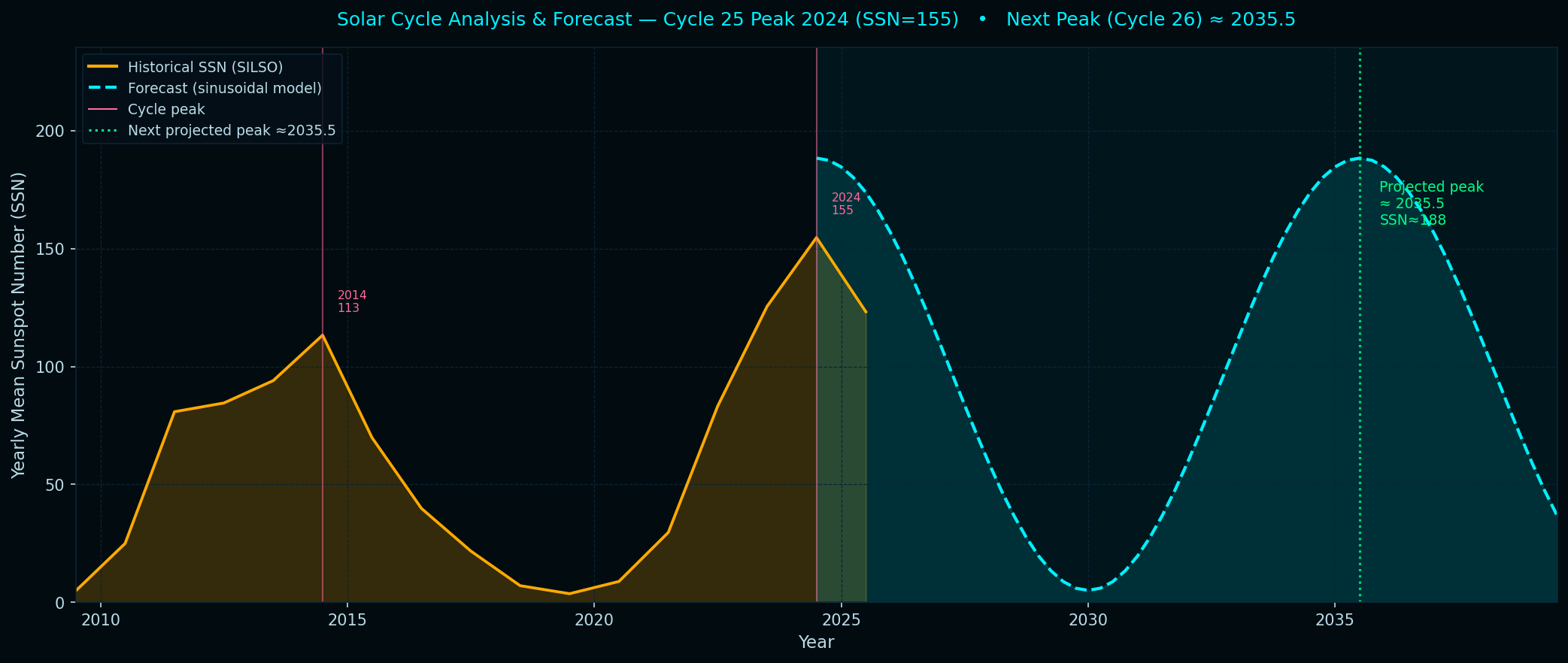
Shaded region = forecast period (sinusoidal model, avg of 8 preceding cycles)
Green dotted line = projected Cycle 26 peak ≈ 2035.5 • Forecast SSN ≈ 188
△ SOLAR CYCLE PEAK HISTORY
CYCLES 18–26| Cycle | Peak Year | Peak SSN | Cycle Length | Notes |
|---|---|---|---|---|
| 18 | 1947.5 | 214.7 | 10 yr | Post-war maximum |
| 19 | 1957.5 | 269.3 | 10 yr | Strongest on modern record |
| 20 | 1968.5 | 150.0 | 11 yr | Weaker cycle |
| 21 | 1979.5 | 220.1 | 11 yr | Very active; 10m/6m openings |
| 22 | 1989.5 | 211.1 | 10 yr | Great Geomagnetic Storm 1989 |
| 23 | 2000.5 | 173.9 | 11 yr | Dot-com solar max; strong X-flares |
| 24 | 2014.5 | 113.3 | 14 yr | Weakest in a century; long minimum |
| 25 | 2024.5 | 154.7 | 10 yr | Exceeded predictions; still provisional |
| 26 (proj) | ~2035.5 | ~188 | ~11 yr | Sinusoidal model forecast |
▶ CYCLE ANALYSIS & FORECAST METHOD
How the Forecast Works
The projection uses a sinusoidal model fitted to the average of the last 8 solar cycle peaks. The average cycle length is 11.0 years, matching the well-established Schwabe cycle.
With Cycle 25 peaking at SSN 154.7 in mid-2024, the next maximum (Cycle 26) is projected around mid-2035, with a forecast peak SSN of approximately 188 — broadly average for modern cycles.
The solar minimum (trough between Cycles 25 and 26) is expected around 2030–2031, when HF conditions will be at their poorest for high bands.
Amateur Radio Implications (G7SYQ)
Solar activity directly controls HF propagation. At cycle maximum (2024), 10m and 12m were excellent for DX. As SSN falls through 2026–2030, expect 10m/12m to become unreliable and 20m/17m/15m to become the primary DX bands.
Sporadic-E (Es) propagation is not strongly correlated with solar cycle and peaks every May–August regardless. Es can produce spectacular 6m and 10m openings even at solar minimum.
From IO93 (Lincolnshire), Es paths to southern Europe and beyond are common June–July. Monitor 28–50 MHz around midday.
⚡ SOLAR FLARE & SPACE WEATHER
NOAA / SWPCLIVE SPACE WEATHER — USEFUL LINKS
✈ SPORADIC-E PROPAGATION (Es)
IO93 LINCOLNSHIRESEASONAL Es ACTIVITY — NORTHERN HEMISPHERE
BAND CONDITIONS OUTLOOK — 2026 DECLINING PHASE
Es MONITORING RESOURCES
ⓘ DATA LICENCE & ATTRIBUTION
SN_y_tot_V2.0.csvThis data is published under the Creative Commons Attribution–NonCommercial 4.0 International (CC BY-NC 4.0) licence (https://goo.gl/PXrLYd), which permits:
• Share — copy and redistribute in any medium or format
• Adapt — remix, transform, and build upon the material
Provided that:
• Attribution — appropriate credit is given and a link to the licence included
• NonCommercial — the material is not used for commercial purposes
• No additional restrictions — no additional legal terms may be applied
This page is a non-commercial personal project by Andy Orchiston (G7SYQ) / orcnet.co.uk.
Last updated: